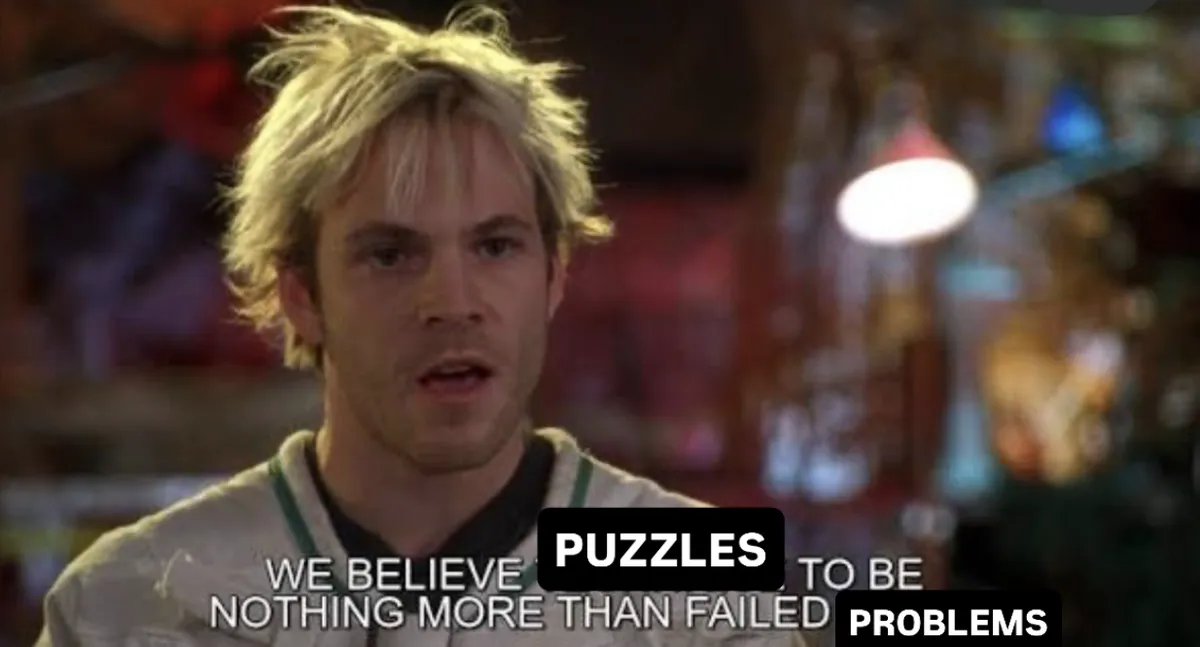
I like solving problems, not puzzles
Puzzles annoy me, that is not really a problem, many things i love to do are built on tension, being annoyed comes with the territory. The suspense of not knowing, sitting with the pain of not understanding, until i do. Solving something is a beautiful feeling. There is something about puzzles that I find it very difficult to find the patience for and I can boil it down to two things. First, I feel a deep hierarchy between myself and the puzzle. The game is very much in control, and I must understand what it wants in its own terms. Second, this dread is never transformed into something else, it is only relieved, until it comes back again. I solve a puzzle and I am greeted by another puzzle, oh cool more of this again. I understand so much of this is due to personal taste, but here I want to get deeper into it.
This is the worst when I play a point and click puzzle games. I imagine this annoying game designer behind the screen who has created this obscure logic which goes something like: ‘The red key inside the cupboard which goes inside the red lock behind the tv and when you open the tv you solve a small puzzle and the tv opens up and the opening the tv wakes up the sleeping person in front of the tv and they see that they need to open the door etc etc etc’. This is fine, it’s Wile E. Coyote trap logic, it’s fun to watch. It’s lovely to see the contraptions, to hear about it, to appreciate it but I do not really like experiencing it myself, even when I can solve them.
So much of puzzle solving feels attached to the feeling of validation. While this might be because of my own ego, there is a part of it that is materially supported too. A puzzle is designed, a puzzle tells you that there is a right way to do a thing. A puzzle tells you that until you do the thing in the specifically right way to do it, you’re not right.Don’t get me wrong, I understand there is a beauty to puzzle design. Understanding your constraints so intimately and exploring different problems those constraints can create. It can be deeply satisfying. Yet, here I am looking for something else.
I don’t think this is the only way to do puzzles. What I find a lot more interesting are problems. Problems are less about a specific solution, but ‘a solution’. It’s less about shoehorning you into a certain way to do a thing, but has more room for appropriation. One of the best feelings in the world for me is to make up a make-shift solution to a problem which I don’t have the right tool for. Trying to open a wine bottle without a corkscrew, yes, that is a delicious problem. Or trying to create soft lights in a room which only has an aggresive overhead light, mmhm.
I think one of the difficulties of designing problems in video games is that we design mechanics specifically for the goals and obstacles we can present through them. Jesper Juul has a nice playable essay about how digital objects can only have limited qualities . When making game objects we represent them only in limited matters, in qualities which are relevant to the way of existing within that world. If there is a knife in a game about combat, it’s usually to attack someone, you can’t make nice wooden trinkets with your knife. There is an inherent attachment between the goals and the mechanics.
For a game to present you problems, instead of puzzles, there needs to be an inherent ambiguity in the possibility space. Perhaps a detachment between the problem, and the tools you can solve it with. A problem is more about it being solved, a puzzle is about being solved a certain way. Puzzles are built on tight mechanics, while problems can be solved in make shift ways.
Not knowing whether a problem is solvable at all might be an important part of the equation too. The ambiguity of not knowing the solution to a thing is a lot more easier to carry when you don’t know if a solution even exists at all. Likewise, the feeling of ‘solving’ is also a lot more delicious if you weren’t sure whether a solution existed too. This is a tension, you probably don’t want to bombard people with unsolvable things, but I think this ambiguity can lead to very unique pleasures in games.
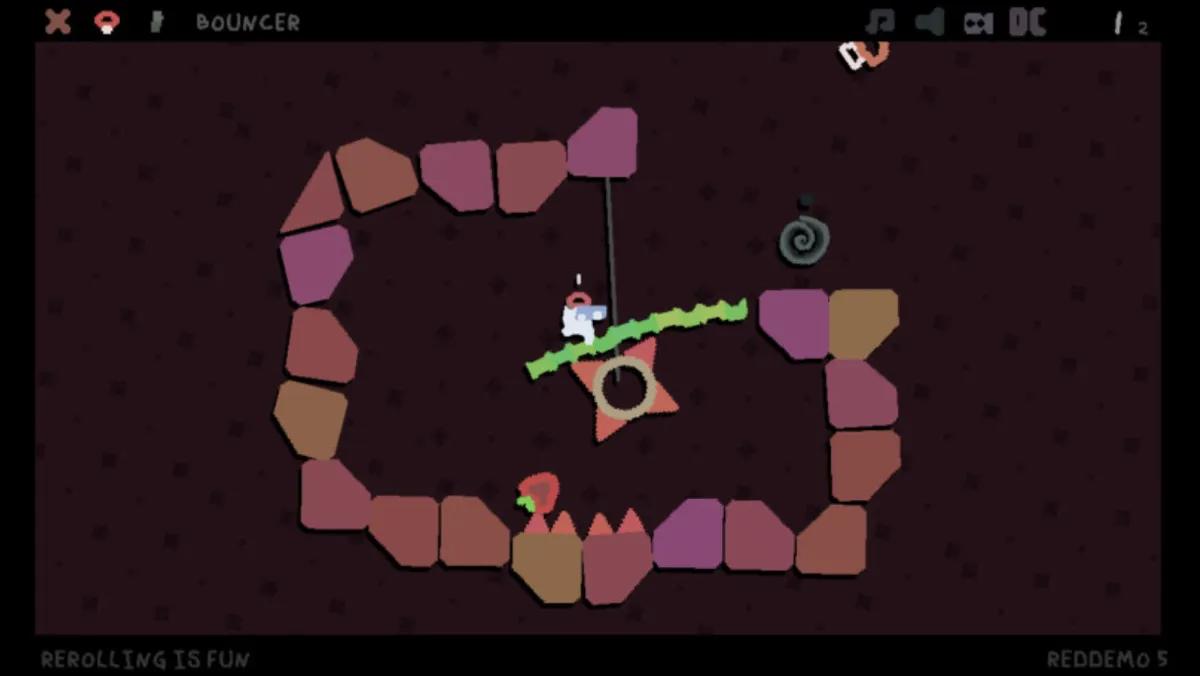
There is a specific game I am thinking about as I write this, and it is about Stuffed Wombat’s ‘Mosa Lina’. It’s a 2d platformer ‘problem’ game. In each level you are given a random set of 3 tools, and you try to reach an objective and come back to the portal you came from to complete the levels. The levels are procedurally generated, and the tools are randomly selected. You do not really know whether the problem you are presented with can be solved until you do, until you can feel it within your grasp, and that feeling is a lot more exciting than starting a level knowing it can be solved.
This game also relies so beautifully on jank. Each mechanic is so attached to wonky physics, the platforming is less about precision but more about finding a wonky solution. Solving the problems feel like attaching the exhaust pipe back into your car with a duct tape, and it feels so beautiful.
I realise that problems exist in games in many different forms already. A lot of strategy games are about expansive possibility spaces which present many interrelated problems (insert that overused Sid Meier quote about interesting choices somewhere). I just think there is some unexplored beauty about tools/mechanics that are not as related to the goals of a game, unexpected solutions, and how to design for them. It’s something I’m thinking about, and maybe I will have more to say about it later. Until then I will enjoy finding wonky solutions to inconsequential problems with joy. Take care.